By Ryan Cole
Table of Contents
ToggleI’ve spent over 8 years working with Toronto businesses, from small shops in Leslieville to service companies covering North York and Etobicoke. And when a business tells me “we’re not showing up,” I already know it’s not one issue.
It’s a combination of signals not lining up.
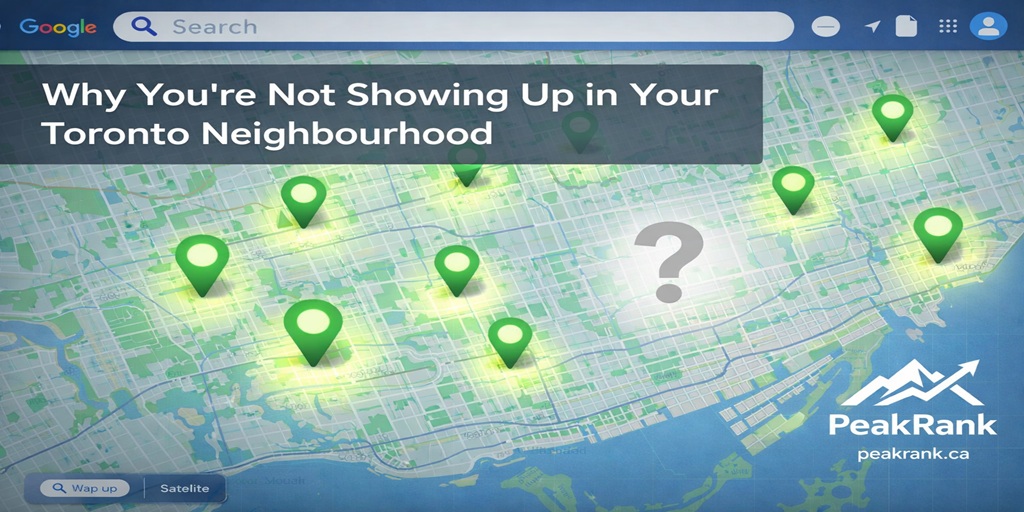
Google isn’t ignoring you. It just doesn’t fully trust where you belong in the local map.
If you want to understand how we fix that at a structural level, take a look at how we work as
👉 Toronto local search specialists
That’s where the real groundwork happens.
Why Neighbourhood Targeting Matters More Than Ever
Toronto isn’t a single SEO market. It’s fragmented.
Someone searching in Scarborough won’t see the same results as someone downtown. Google prioritizes proximity + relevance.
If your site doesn’t clearly signal:
- Where you operate
- Which areas you serve
- How your services relate to those areas
You won’t rank consistently.
What Works
- Dedicated pages for each service area
- Mentioning real neighbourhoods naturally
- Internal links connecting nearby zones
- Content reflecting local intent
That’s how you build geographic trust.
Google Business Profile Signals That Drive Rankings
Your Google Business Profile is one of the strongest ranking factors locally.
But most profiles are under-optimized.
What Actually Moves the Needle
- Correct primary category (huge ranking impact)
- Secondary categories aligned with services
- Service descriptions written for search intent
- Regular posting activity
- Reviews mentioning locations
Real Insight
A Toronto client improved map rankings just by restructuring categories and encouraging reviews with neighbourhood mentions.
No backlinks involved.
Search Intent Changes by Neighbourhood
Not all searches are equal.
Downtown users often compare options.
Suburban users often search with urgency.
If your content doesn’t reflect that difference, rankings struggle.
Example
- “Emergency electrician Scarborough” → fast response messaging
- “Best electrician Toronto downtown” → trust + reviews
Matching this intent improves both rankings and conversions.
Internal Linking Structure That Boosts Local Rankings
Most sites lose rankings because pages are isolated.
What We Implement
- Link service pages to related locations
- Connect nearby neighbourhood pages
- Use anchor text reflecting real queries
This builds topical and geographic relevance.
Technical SEO Issues That Quietly Kill Rankings
These don’t show on the surface, but they block growth.
Common Problems
- Pages not indexed
- Slow mobile load times
- Duplicate content
- Crawl inefficiencies
Fixing these often unlocks rankings without adding content.
Keyword Cannibalization (The Silent Ranking Killer)
This is one of the biggest issues I fix in Toronto sites.
Multiple pages targeting the same keyword confuse Google.
What Happens
- Google rotates rankings between pages
- No page gains full authority
- Rankings stay stuck mid-page
How We Fix It
- Assign one primary keyword per page
- Merge overlapping pages
- Rebuild internal linking to support hierarchy
On one project, fixing cannibalization alone moved rankings from #11 to #4.
Citation Building (Local Authority Backbone)
Citations are mentions of your business across directories.
They’re not just for visibility. They reinforce trust.
What We Focus On
- High-quality Canadian directories
- Industry-specific listings
- Consistent business details
Important
Low-quality or spam citations can hurt rankings.
Quality matters more than quantity.
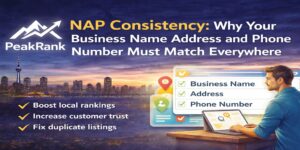
NAP Consistency (Critical for Local Trust)
NAP = Name, Address, Phone Number
If this information isn’t consistent across platforms, Google loses confidence.
What We Fix
- Standardize formatting across all listings
- Remove duplicate or outdated entries
- Align website + Google Business Profile + directories
Even small differences (like “St.” vs “Street”) can impact trust signals.
Schema Markup for Local SEO
Schema helps Google understand your business clearly.
Most sites either don’t use it or use it incorrectly.
What We Implement
- LocalBusiness schema
- Service schema
- FAQ schema
- Review schema
Why It Matters
It improves:
- Search visibility
- Rich results eligibility
- Context for local queries
Competitor Analysis (Toronto-Specific Reality Check)
This is where most strategies fail.
They don’t analyze what’s already ranking locally.
What We Look At
- Top-ranking pages in specific neighbourhoods
- Content depth and structure
- Internal linking patterns
- Backlink sources
Real Insight
In Toronto, competitors ranking well usually:
- Have stronger location relevance
- Cover more subtopics
- Maintain consistent internal linking
We don’t copy them. We out-structure them.
The Mid-Game Shift That Separates Winners
Most businesses stop too early.
They optimize… then wait.
That’s where growth stalls.
What We Do Instead
- Expand existing pages
- Add missing subtopics
- Strengthen internal links
- Improve engagement signals
One Toronto page moved from #9 to #3 with just content expansion and linking improvements.
That’s execution.
If you want to understand how we scale this across areas, see how we work as
👉 GTA SEO growth experts
Why Businesses Trust Peak Rank
I’ve worked in Toronto SEO for over 8 years.
Not from reports. From actual campaigns.
What Makes Our Approach Different
- Manual audits (no automation shortcuts)
- Real keyword mapping based on intent
- Content built for users first
- Continuous testing and refinement
Standards We Follow
- Google Search Essentials
- Core Web Vitals optimization
- Structured data best practices
- Clean crawl architecture
We don’t guess. We measure.
If You’re Still Not Ranking, Here’s the Truth
If your business isn’t showing locally, it’s not because SEO is too competitive.
It’s because:
- Your signals aren’t aligned
- Your structure isn’t clear
- Your authority isn’t strong enough
Fix those, and things change.
What Happens Next
If you want clarity, start with a real audit.
Not a generic checklist.
A breakdown of:
- What’s blocking rankings
- What needs fixing first
- What will move results fastest
That’s how we approach SEO at Peak Rank.
Because once the problem is clear, the solution becomes simple.
FAQ
Why is my business not showing in my Toronto neighbourhood?
Because your website and Google profile lack strong local signals like targeted content, consistent citations, and optimized listings.
What is keyword cannibalization in SEO?
It happens when multiple pages target the same keyword, causing Google to split ranking signals and reduce visibility.
How important are citations for local SEO?
Citations help validate your business information and improve trust, which directly impacts local rankings.
What is NAP consistency and why does it matter?
NAP consistency ensures your business details match across platforms, improving trust and ranking stability.
Does schema markup help local SEO?
Yes, it helps search engines understand your business better and improves visibility in rich results.
How do I outrank competitors locally?
By building stronger location relevance, better content structure, and consistent authority signals across your site.