
Published October 9, 2026 · PeakRank.ca
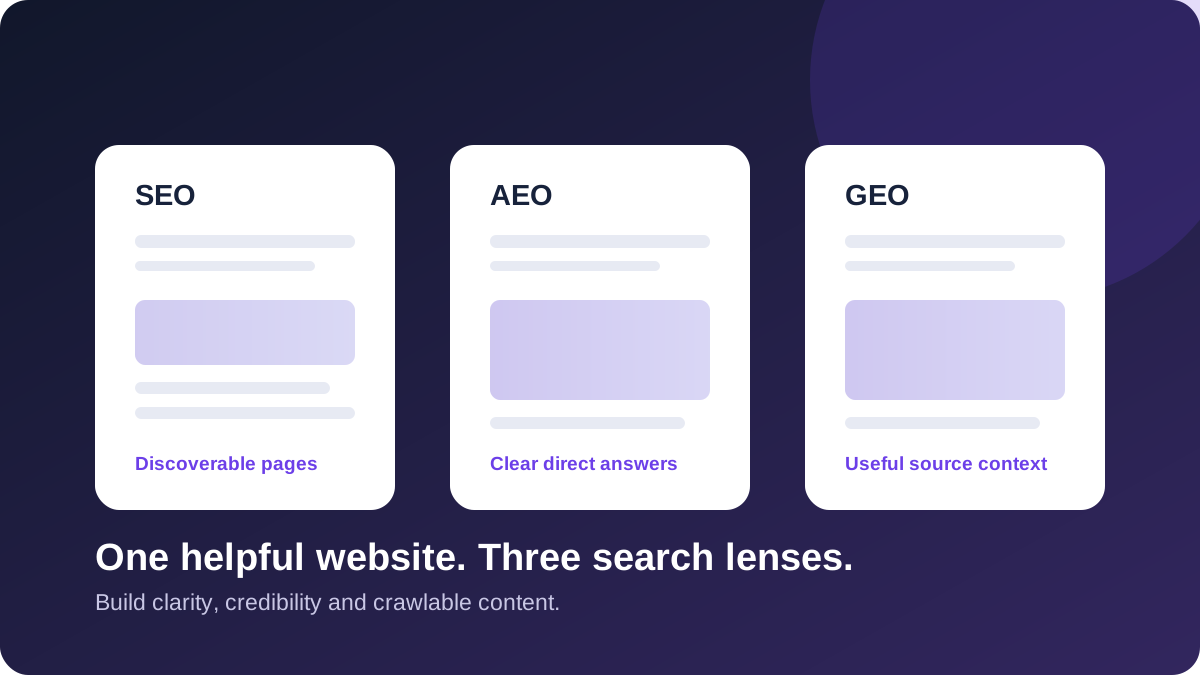
Search behaviour now includes more than a list of traditional blue links. People may browse standard search results, read an answer panel, ask a conversational assistant or explore an AI-generated summary. The labels SEO, AEO and GEO describe related approaches to being understood and discovered across these experiences. They are not three completely separate disciplines, and none can guarantee that a website will be ranked or cited by a particular platform.
What SEO means
Search engine optimisation (SEO) helps search engines discover, crawl, understand and present useful pages for relevant queries. It includes technical accessibility, information architecture, page content, internal links, structured data where appropriate and the reputation earned by a site. Good SEO starts with a clear audience and a page that genuinely satisfies their needs. It also requires measurement: impressions and clicks show search exposure, while qualified enquiries help connect visibility to business value.
What AEO adds
Answer engine optimisation (AEO) focuses on making information clear and easy to interpret when a person asks a direct question. Useful techniques include concise explanations, descriptive headings, well-written FAQs where they genuinely help, definitions of specialist terms and transparent details about services, pricing factors, processes and limitations. Answer-ready writing should still sound natural. Adding a large block of generic questions or repetitive phrases simply to target a feature can make the page less useful.
What GEO means in practice
Generative engine optimisation (GEO) is commonly used for work intended to improve how content may be understood, retrieved or referenced by generative AI search experiences. In practice, the foundations overlap with good SEO and AEO: original information, clear page structure, crawlable content, trustworthy sourcing, consistent entity details and answers that add something useful. AI systems differ in how they retrieve and cite sources, and their outputs can change. No checklist can guarantee inclusion in an AI answer.
Why the three approaches overlap
A well-structured service page can help a search crawler understand the page, help a reader quickly find an answer and give an AI system clearer context about the business. The shared work is often the highest-value work: keep important content accessible, explain concepts plainly, support claims with evidence and make it easy for visitors to verify who you are. Treat SEO, AEO and GEO as complementary lenses for content quality and discoverability rather than separate content factories.
Create pages around real customer questions
Start with the questions customers ask before choosing a provider. A service page might explain who the service is for, the steps involved, what affects cost, what access is required, how success is measured and which factors can delay results. A supporting article can answer a narrower question in more detail and link to the relevant service page. Avoid publishing near-identical pages for minor keyword variations. Each page should have a distinct purpose and add information beyond what is already available.
Use internal links to clarify relationships
Internal links help readers move from an educational answer to the service or location information they need. Use anchor text that describes the destination, and place links in the sentence where they are relevant. For example, a business exploring technical improvements can read about our SEO and search visibility services; a company serving Toronto can review our Toronto SEO page. Link back to useful guides from relevant service pages when doing so helps visitors understand a process or decision.
Technical foundations still matter
Make sure important content is available as crawlable HTML, pages return appropriate status codes, canonical tags identify preferred URLs and internal links use stable destinations. Use structured data that accurately describes visible page content, and validate it before release. Schema can help systems interpret entities and page types, but it is not a shortcut to ranking or AI citations. Keep the mobile experience fast and accessible, and do not hide essential answers behind interactions that crawlers or visitors may struggle to use.
Measure progress responsibly
Track search performance in Search Console, engagement and conversions in analytics, and real customer questions received through calls or forms. If AI visibility is a priority, maintain a repeatable set of relevant prompts and record the platform, date, wording and whether a source was cited. Treat these checks as directional observations, not a universal ranking metric: answers vary by location, account, prompt and product changes. Use the findings to improve content usefulness rather than chase a single screenshot.
A sensible order of work
First resolve indexability, broken navigation and unclear service pages. Next strengthen core pages with original, specific information and links that help visitors continue their journey. Then add supporting articles for unanswered questions and improve structured data where it accurately applies. Finally, measure outcomes and refresh pages when products, services or source documentation change. This sequence gives the website a solid foundation before spending time on speculative tactics.
PeakRank.ca brings these practices together through its SEO, AEO and GEO services. For a local-market example, see our Toronto SEO services page. Read our other search visibility guides for practical topics that support the same goal: helping people find clear, credible and relevant information.
Want to improve your search visibility?
Tell us about your website, market and goals. We’ll help you identify practical next steps.