When a Toronto business suddenly jumps into the Google Map Pack, most people assume it’s random or driven by ad spend. After working in SEO for more than 8 years, I can confidently say that’s rarely the case.
I’m Ryan Cole from Peak Rank, and I’ve audited local SEO campaigns across Toronto neighborhoods including North York, Etobicoke, Scarborough, Mississauga, Downtown Core, and East York. The same ranking patterns appear repeatedly across industries.
Google’s local algorithm is built around trust, relevance, authority, and user behavior. Businesses that understand those signals consistently outperform competitors — even without massive marketing budgets.
This guide explains what Google actually evaluates when ranking local businesses in Toronto and how smart companies are adapting their SEO strategies for both traditional search results and AI-powered search experiences.
Why Toronto Local SEO Is More Competitive Than Most Cities
Toronto is one of Canada’s most competitive digital markets. Nearly every industry — from dentists and law firms to HVAC companies and real estate agencies — competes aggressively for local visibility.
Google has to decide:
- Which business deserves the top Map Pack spots
- Which websites are most trustworthy
- Which pages best answer local intent
- Which companies users engage with most
That means rankings are influenced by much more than keywords alone.
Businesses trying to rank in Toronto face additional challenges:
- High domain competition
- Dense service-area overlap
- Aggressive Google Business Profile optimization
- Strong backlink competition
- Rapidly growing AI-generated content
The businesses succeeding right now are combining technical SEO, local relevance, user experience, and authority-building together.
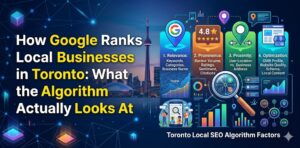
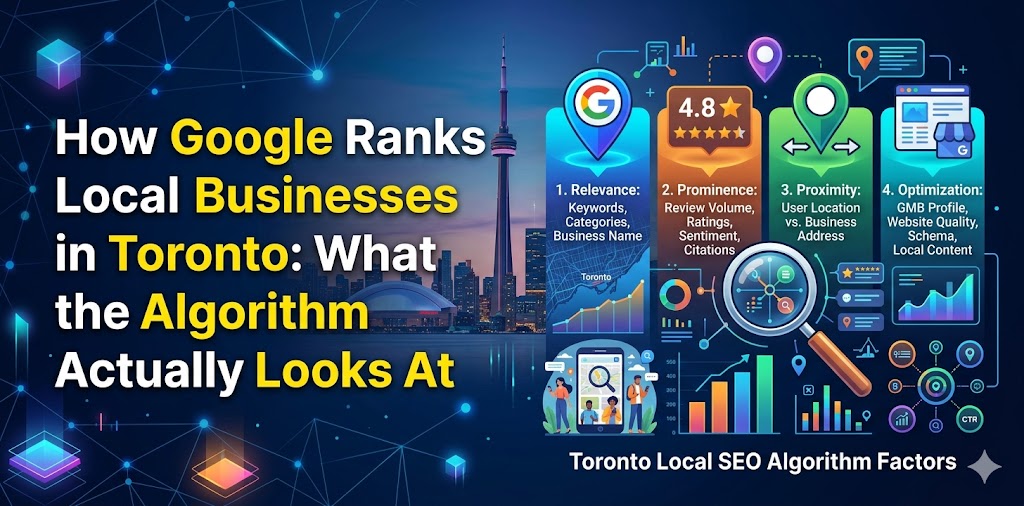
Google’s Local Algorithm Focuses on Three Core Factors
Google publicly mentions three major local ranking signals:
- Relevance
- Distance
- Prominence
But the real-world algorithm goes much deeper than that.
1. Relevance: How Closely Your Business Matches Search Intent
Google wants to show businesses that directly solve the user’s problem.
For example:
- “Emergency plumber downtown Toronto”
- “best brunch near Liberty Village”
- “Toronto immigration lawyer”
Google analyzes:
- Website content
- Google Business Profile categories
- Service pages
- Reviews
- Local keywords
- Structured data
- User behavior
One mistake I frequently see is businesses creating generic service pages with almost no location depth.
A Toronto-focused page should mention:
- Neighborhoods served
- Local customer scenarios
- Region-specific problems
- Service-area expertise
Generic pages rarely compete well anymore.
2. Distance: Physical Proximity Still Matters
Google heavily personalizes local results based on where the searcher is located.
Someone searching from:
- North York
- Downtown Toronto
- Etobicoke
- Scarborough
may see entirely different businesses for the same search.
This is why Google Business Profile optimization matters so much for local rankings.
Businesses closer to the searcher often gain an advantage — but proximity alone won’t outrank stronger authority signals.
3. Prominence: Authority and Trust Signals
Prominence is where most ranking separation happens.
Google evaluates:
- Reviews
- Backlinks
- Brand mentions
- Website authority
- Engagement signals
- Content depth
- Business reputation
This is why established local brands tend to dominate Map rankings consistently.
However, smaller businesses can still compete by building stronger topical authority and localized trust signals.
Google Business Profile Optimization Impacts Rankings More Than Most Businesses Realize
Over the past two years, Google Business Profile signals have become significantly stronger.
I’ve seen businesses jump rankings simply by improving:
- Category selection
- Service descriptions
- Review quality
- Geo-tagged images
- Posting frequency
- Q&A optimization
Many Toronto companies still treat their profile like a basic directory listing.
That’s a major mistake.
High-performing local profiles usually have:
- Consistent review growth
- Real customer photos
- Detailed services
- Strong engagement
- Local relevance in reviews
- Frequent updates
One useful tactic we use at Peak Rank is encouraging customers to mention:
- the service performed,
- neighborhood,
- and experience details naturally inside reviews.
That helps Google associate the business with localized search intent.
Website Quality Still Plays a Massive Role in Local Rankings
Some businesses believe Google Maps optimization alone is enough.
It isn’t.
Google cross-checks your website constantly to validate trust and expertise.
Important website ranking factors include:
Page Speed
Slow websites lose rankings and conversions.
This is especially important in Toronto because mobile search behavior is extremely high during:
- commuting hours,
- lunch breaks,
- and after-work searches.
Localized Service Pages
Strong local pages include:
- Toronto-specific content
- Service details
- FAQs
- Local examples
- Neighborhood mentions
- Internal linking
Thin pages almost never rank competitively anymore.
Technical SEO
Google evaluates:
- crawlability,
- schema markup,
- indexation,
- mobile usability,
- Core Web Vitals,
- and site structure.
A technically weak website often limits rankings regardless of backlinks.
Reviews and User Engagement Directly Influence Local Visibility
Reviews are no longer just social proof.
They’re algorithmic ranking signals.
Google evaluates:
- review velocity,
- review diversity,
- response quality,
- keyword relevance,
- and user engagement.
A business with:
- recent reviews,
- detailed responses,
- and strong customer interaction
usually performs better locally.
One thing many agencies ignore is click behavior.
Google tracks:
- clicks,
- calls,
- direction requests,
- time on site,
- and engagement patterns.
If users consistently choose your listing and stay engaged, rankings often improve over time.
That behavioral data matters more than most businesses realize.
Local Backlinks Still Matter — But Relevance Matters More
Ten years ago, businesses could rank using random directory links and bulk backlinks.
That approach no longer works consistently.
Google now prioritizes:
- local relevance,
- topical authority,
- and trust.
Some of the strongest local backlinks come from:
- Toronto business associations
- Local sponsorships
- Community events
- Industry publications
- Regional blogs
- Chamber memberships
At Peak Rank, we focus on acquiring links that make logical local sense.
A relevant Toronto-based mention often provides more ranking value than dozens of low-quality backlinks.
AI Search Is Changing Local SEO in Toronto
Google’s AI-generated search summaries are reshaping local visibility rapidly.
Businesses that structure content properly now have opportunities to appear inside:
- AI Overviews,
- conversational search results,
- and voice-assisted searches.
Content performing best for AI visibility usually includes:
- direct answers,
- FAQ sections,
- semantic structure,
- expert insights,
- and strong topical organization.
That’s one reason generic AI-generated content struggles long term.
Google increasingly favors businesses demonstrating:
- real expertise,
- firsthand experience,
- and local authority.
Local Insight: What Works Specifically in Toronto
Toronto search behavior changes dramatically by neighborhood.
For example:
- Downtown users often search on mobile with urgent intent.
- Suburban homeowners spend more time comparing services.
- Condo-heavy areas generate stronger “near me” searches.
- Certain industries perform better with neighborhood landing pages than city-wide targeting.
One thing I’ve consistently noticed is that businesses using hyper-local strategies outperform broader generic campaigns.
Targeting:
- Liberty Village,
- Leslieville,
- The Junction,
- North York,
- or Etobicoke individually
often creates faster ranking wins than competing for broad “Toronto” terms immediately.
That local precision matters.
Why Experience Matters in Modern SEO
Google’s algorithm changes constantly.
Over the past 8+ years, I’ve worked through:
- core updates,
- spam updates,
- Helpful Content updates,
- mobile-first indexing,
- and AI search evolution.
The businesses surviving long term are the ones building genuine authority instead of chasing shortcuts.
At Peak Rank, we focus heavily on:
- ethical SEO practices,
- technical optimization,
- localized content strategy,
- and sustainable ranking growth.
No inflated promises. No risky tactics.
Just practical SEO built for long-term visibility.
Frequently Asked Questions
How does Google rank local businesses in Toronto?
Google ranks local businesses based on relevance, distance, prominence, reviews, website quality, backlinks, and user engagement signals.
Do reviews help local SEO rankings?
Yes. Reviews influence trust, click-through rates, engagement, and local ranking signals within Google Maps and organic search.
How important is Google Business Profile optimization?
It’s critical. A properly optimized Google Business Profile significantly improves visibility in local search and Map Pack results.
Can small businesses compete in Toronto SEO?
Absolutely. Smaller businesses often outperform larger competitors using hyper-local content, better engagement, and stronger neighborhood targeting.
Why choose Peak Rank for Toronto local SEO?
Peak Rank combines 8+ years of SEO experience, technical expertise, local market understanding, and modern AI-focused optimization strategies designed for long-term growth.
Work With Peak Rank
If your business wants stronger Google Maps visibility, better organic rankings, and more qualified local traffic, Peak Rank can help build a strategy tailored specifically for Toronto search competition.
Visit Peak Rank Official Website to learn more about our local SEO services and request a customized SEO strategy consultation.