A Toronto-based ecommerce store owner once told me, “We’re getting traffic, but no one is buying.”
We reviewed the site. The products were fine. Pricing was competitive. But something felt off.
No real author. No business credibility. No trust signals.
That’s when E-E-A-T became the turning point.
I’m Ryan Cole from Peak Rank, and after working with businesses across Toronto, I can tell you this—Google doesn’t just rank websites anymore. It ranks trust.
If you’ve explored 👉 (Toronto ecommerce SEO services), you’ll notice one common factor across successful sites: credibility.
That’s what E-E-A-T is all about.
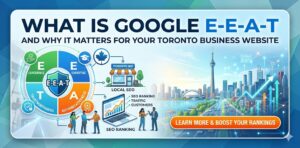
What Is Google E-E-A-T?
E-E-A-T stands for:
- Experience
- Expertise
- Authoritativeness
- Trustworthiness
These are the signals Google uses to evaluate whether your website deserves to rank.
It’s not a single ranking factor. It’s a framework.
And in competitive markets like Toronto, it’s often the difference between page 1 and page 3.
Why E-E-A-T Matters More in Toronto
Toronto is one of the most competitive digital markets in Canada.
That means:
- More businesses competing for the same keywords
- More options for users
- Higher expectations for credibility
From what I’ve seen, Google is stricter here.
If your website lacks trust signals, it doesn’t matter how optimized your keywords are.
You won’t rank consistently.
How E-E-A-T Impacts Rankings and Conversions
This is where most businesses misunderstand things.
E-E-A-T doesn’t just affect rankings. It affects behavior.
When your site shows strong credibility:
- Users stay longer
- Bounce rates drop
- Conversions increase
When it doesn’t:
- Users leave quickly
- Google notices
- Rankings drop
This is especially important for service-based and ecommerce businesses.
Experience: Show You Actually Do the Work
Google wants to see real-world experience.
Not just theory.
What works:
- Case studies
- Real project examples
- Before/after results
- Personal insights
From my experience, pages that include actual work examples outperform generic content every time.
Expertise: Prove You Know What You’re Doing
Anyone can write content.
But not everyone demonstrates expertise.
Build expertise by:
- Writing detailed, practical content
- Explaining processes clearly
- Avoiding vague statements
If your content sounds like it could apply to any city, it won’t stand out.
Authoritativeness: Build Recognition in Your Industry
Authority comes from external validation.
This includes:
- Backlinks from relevant websites
- Mentions across platforms
- Consistent branding
Midway through most campaigns, this is where I see momentum build.
If you connect this with 👉 (ecommerce search optimization Toronto strategies), authority plays a huge role in scaling rankings.
Trustworthiness: The Most Important Factor
If your site doesn’t feel trustworthy, nothing else matters.
Key trust signals:
- Clear contact information
- Business address
- Reviews and testimonials
- Secure website (HTTPS)
- Transparent policies
This is where many Toronto businesses lose potential customers.
Practical Ways to Improve E-E-A-T on Your Website
Let’s make this actionable.
1. Add Real Author Profiles
Every blog or page should have:
- Author name
- Experience
- Background
This builds credibility instantly.
2. Showcase Real Results
Don’t just say you’re good.
Show:
- Rankings achieved
- Traffic growth
- Client outcomes
This builds both trust and authority.
3. Improve Website Transparency
Make it easy for users to trust you:
- Add business details
- Include location information
- Display certifications if available
4. Strengthen Content Quality
Avoid:
- Generic writing
- Repetitive ideas
- Surface-level explanations
Focus on depth and clarity.
5. Build Local Authority
For Toronto businesses, local signals matter.
- Mention areas you serve
- Create location-based content
- Get local backlinks
This strengthens relevance.
Local Insight: How Toronto Users Judge Websites
After working with businesses across different areas:
- Downtown users trust brands with strong design and reviews
- North York users compare multiple options
- Scarborough users look for clarity and pricing
- Vaughan users rely heavily on reputation
Your website should reflect these expectations.
Common E-E-A-T Mistakes
I see these often:
- Anonymous content
- No proof of experience
- Weak or no reviews
- Missing business details
- Over-optimized but low-value content
These don’t just hurt rankings—they reduce conversions.
What Happens When E-E-A-T Is Strong
When your site builds trust:
- Rankings stabilize
- Traffic quality improves
- Leads increase
- Conversion rates go up
This is where SEO starts delivering real business results.
The Shift Happening Right Now
Google is moving toward:
- Trust over keywords
- Experience over theory
- Value over volume
If your content doesn’t reflect real-world expertise, it won’t perform long-term.
FAQs
What is Google E-E-A-T in SEO?
It’s a framework Google uses to evaluate Experience, Expertise, Authoritativeness, and Trustworthiness of a website.
Does E-E-A-T directly affect rankings?
Not as a single factor, but it influences how Google evaluates overall content quality and credibility.
How can I improve E-E-A-T for my Toronto business?
Add real experience, improve content quality, build authority, and include trust signals like reviews and business details.
Why is E-E-A-T important for ecommerce websites?
Because users need trust before making purchases, and Google prioritizes trustworthy sites in rankings.
How long does it take to see results from E-E-A-T improvements?
Some improvements can show quickly, but stronger authority and trust typically build over several months.
Conclusion
If your website isn’t converting, it’s often not a traffic problem.
It’s a trust problem.
At Peak Rank, we focus on building authority and credibility alongside SEO, so rankings actually translate into business growth.
If you want your site to rank and convert, E-E-A-T isn’t optional anymore.